





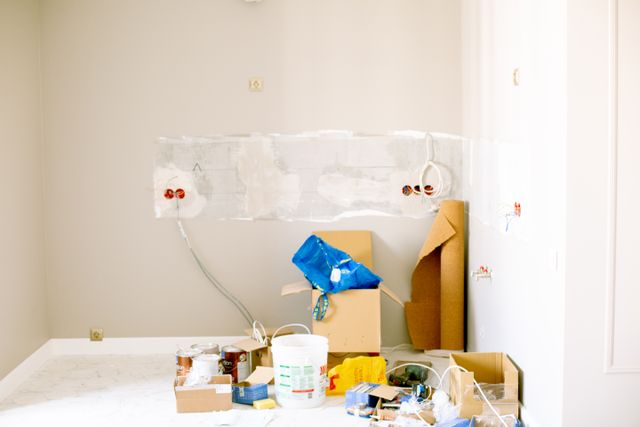
What really happens when a home renovation gets underway and the junk starts piling up? In Australia, the answer is a whole lot bigger than most people expect, and the sheer scale often catches homeowners by surprise. A typical kitchen or bathroom upgrade in a household generates anywhere between 1.5 and 2.5 tonnes of mixed rubbish. This rapidly turns a routine upgrade into a major headache when it comes to getting rid of it. In cities like Melbourne, this creates a huge demand for rubbish removal Melbourne, with private contractor services reporting a boost of more than 18% in demand during peak construction seasons, particularly in spring and summer.
Composition and Material Breakdown
As you start sorting through all the rubbish collected from renovations, it becomes really clear just how complex it all is. The material mix is not uniform. Instead, you have a mix of heavy and light components all getting carted around together in the same load. 40 to 45% of the total weight is concrete and masonry, followed by timber at 20 to 25% and metals at 10 to 15%, with all the rest being a jumble of mixed residuals. And if all that is not bad enough, EPA Victoria data shows that contamination alone can increase landfill rejection rates by up to 22%. This directly increases processing costs. Even a tiny bit of contamination can cause huge problems. 1% plasterboard contamination, for instance, can be enough to downgrade an entire recycling batch, which adds up to a whacking $80 per tonne in extra processing costs. As a result, this creates inefficiencies that just won’t go away, even in regulated systems like those in place in New South Wales and Victoria.

The Regulatory Framework and Landfill Economics
Waste management in Australia operates under a patchwork of state-based rules that are generally in line with the National Waste Policy Action Plan 2019. These rules are designed to reduce our reliance on landfills by applying financial pressure to do so. In Victoria, for example, the landfill levy is around $125 per tonne for municipal solid waste. In New South Wales, it’s a bit higher in metropolitan regions, over $170 per tonne.
Segregating & Collecting Waste, The Key to Better Recycling Outcomes
Studies have shown that the point at which you sort waste can make a huge difference in the end result. For instance, separating materials during demolition can improve recycling rates by as much as 35% compared to sorting waste after its been collected. On the flip side, manual sorting facilities can only recover around 10 to 15% less of reusable materials from pre-sorted streams. Skip bin systems also illustrate this difference. For example, a standard 6 metre skip bin in parts of Australia can hold around 4.5 tonnes of mixed renovation waste. But if the waste is contaminated with more than 20% of non-recyclables, the amount of recyclables you can recover drops by almost half. However, if you use separate bins for concrete, timber and metals, you can recover up to 80% of the material. Additionally, that’s with a reduction in processing costs of around AUD 60 to 100 per tonne.
The Carbon Footprint of Transporting Waste
But it’s not just about sorting and recycling, it’s also about how you get the waste to the factory in the first place. A single diesel skip truck can pump out around 1.1 to 1.3 kg of CO2 per km, which is not exactly great. And when you add in the fact that urban collection routes in cities like Sydney and Melbourne often cover 60 to 120 km per job, we’re talking about a whopping 70 to 150 kg of CO2 per trip. Not to mention the emissions from the factories that process the waste. There are some efficiency measures that can help though. Optimising your routes can cut emissions by as much as 18%, while load consolidation can bring down transport costs by around AUD 25 to 40 per tonne. Still, that’s not always easy to achieve, especially when you’re dealing with smaller renovation projects where getting contractors to work together in a consistent way can be a bit of a challenge.










Leave a comment